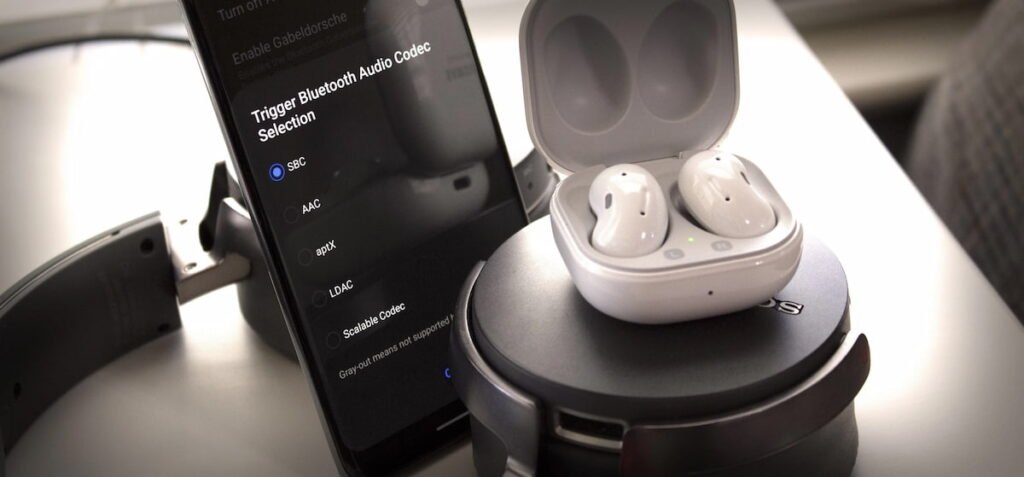
Music from a phone is transmitted to headphones through Bluetooth.
For this transmission to work, and for both devices to be able to understand each other, the phone and the headphones must use the same language.
That language is called a Bluetooth audio codec.
Because of that, when talking about bluetooth codecs, it does not only mean headphones or phones by themselves, but the shared system both devices use to compress and read audio data.
Only when both sides use the same codec can the audio data compressed on the phone be decompressed and played back as sound on the headphones.
Besides phones and headphones, Bluetooth audio is also used with music players, Bluetooth speakers, home audio systems, and car audio systems.
However, to keep this text focused and not too long, the phone is used as the audio source and the headphones as the receiving device.
This setup represents the most common use case for bluetooth audio on smartphones, phone Bluetooth audio, and mobile Bluetooth audio.
How Bluetooth Audio Works on Phones
To better understand how Bluetooth audio works, let’s look at a simple example.

You play an MP3 file on your phone and connect Bluetooth headphones that support the LC3 codec.
First, the phone decodes the MP3 file into PCM (Pulse Code Modulation) data.
Then, the LC3 codec compresses the PCM data into an LC3 audio stream.
The LC3 data is transmitted via Bluetooth to the headphones.
On the headphone side, the LC3 data is decoded back into PCM.
After that, the DAC converts the PCM data into an analog signal, which is then played as sound.
This is the basic process behind bluetooth audio codecs and wireless audio codecs used on smartphones.
Why You Should Care About Bluetooth Codecs
Different codecs are designed for different purposes or to compete with each other.
 Understanding the differences between codecs helps you choose the right headphones or phone that match your actual usage.
If you choose the wrong codec, the experience will be worse.
You may spend more money but still get poor sound quality or noticeable delay.
There are three main factors that affect real-world Bluetooth audio experience.
Sound Quality, Latency, and Compatibility
Sound quality
A better codec preserves more audio detail.
This results in clearer sound and better overall listening experience.
Latency
Latency is the delay between the phone sending audio and the headphones playing it.
Lower latency reduces delay and is suitable for watching videos or playing games.
When listening to music, latency is usually not important.
This is why audio latency Bluetooth performance matters depending on how you use Bluetooth audio.
Compatibility
Both the source device (phone, music player) and the receiving device (headphones, speakers) must support the same codec to use it.
This is especially important for bluetooth codecs on phones, because codec support depends on hardware and software.
| Factor | What It Affects | Why It Matters |
| Sound Quality | Audio detail and clarity | Better immersion and listening experience |
| Latency | Audio delay | Important for video and gaming |
| Compatibility | Device support | Both devices must support the same codec |
Basic Audio Concepts You Need to Understand
Each Bluetooth codec defines different limits for audio-related values.
To understand how codecs work, you need to understand the technical values behind them.
There are three main values you should care about.
Sample Rate (kHz)
Sample rate is the number of times audio is sampled in one second.
In other words, it defines how many thousands of audio samples are taken per second.
The more samples are taken, the higher the resolution.
CD-quality music uses a sample rate of 44.1 kHz.
High-resolution music can use sample rates up to 192 kHz.
You can imagine this like a door in front of your ears.
Outside the door, sound is happening continuously.
If you open and close the door quickly many times in one second, you hear more detail.
If you open and close it slowly, some details are lost.
Bit Depth (bit)
Bit depth is how much audio information is captured in each sample.
It defines how “deep” each sample is.
Using the same door example, bit depth is how wide the door opens each time.
A wider opening lets more sound in, which results in richer and more detailed audio.
Higher bit depth means more detail and better sound quality.
Bitrate (kbps)
Bitrate is the amount of audio data transmitted over Bluetooth each second.
Bitrate is calculated from sample rate and bit depth.
The unit for bitrate is kbps.
In simple terms, higher bitrate usually means better sound quality.
Sample rate, bit depth, and bitrate are the core elements of bluetooth audio compression and bluetooth sound quality.
Latency (ms)
Latency is the time between the phone sending audio and the headphones playing it.
It is measured in milliseconds.
Lower latency means better audio and video synchronization when watching movies or playing games.
When listening to music, latency is not critical.
| Latency Range | User Experience |
| < 40 ms | Excellent for gaming and video |
| 40–80 ms | Good, slight delay possible |
| 80–150 ms | Noticeable in gaming |
| > 150 ms | Poor sync, not suitable for gaming |
Common Bluetooth Audio Codecs Used Today
At the moment, there are many bluetooth audio codecs in use.
Some are very old, some are newer, and some are designed to replace older standards.
Each codec exists for a reason.
Some focus on compatibility, some on sound quality, some on low latency, and some on power efficiency.
Below are the most common codecs you will encounter when using bluetooth audio on smartphones.
| Codec | Audio Quality | Best Use Case |
| SBC | 200–328 kbps · 16-bit / 44.1 kHz | Basic compatibility, universal support |
| AAC | Up to 256 kbps · 16-bit / 44.1 kHz | Music and video, especially on phones |
| aptX | 352 kbps · 16-bit / 44.1 kHz | Video playback, casual gaming |
| aptX LL | 352 kbps · 16-bit / 44.1 kHz | Gaming and movies with very low latency |
| aptX HD | 576 kbps · 24-bit / 48 kHz | High-quality music listening |
| aptX Adaptive | 279–860 kbps · up to 24-bit / 96 kHz | Mixed use: music, video, gaming |
| LDAC | Up to 990 kbps · 24-bit / 96 kHz | Hi-Res audio, sound quality priority |
| LC3 | 16–345 kbps · up to 32-bit / 48 kHz | LE Audio, low power, future standard |
SBC Codec
SBC (Subband Codec) is the default codec required for all Bluetooth devices that use the A2DP profile.
It was developed by the Bluetooth SIG and has existed for a long time.

SBC provides basic sound quality and low power consumption.
Because it is mandatory, every Bluetooth audio device supports it.
If you don’t care about codecs at all, chances are high that you are using SBC.
In most cases, SBC does not provide good sound quality for music and is also not ideal for watching videos or gaming due to higher latency.
This codec has been around for more than 30 years.
Today, it is being replaced by newer codecs such as LC3, which is part of Bluetooth LE Audio.
AAC Codec
AAC (Advanced Audio Coding) was developed by Apple and is widely used on iPhones and other Apple devices.
It is also supported on some Android phones.

AAC usually works at a maximum bitrate of around 256 kbps, with 16-bit / 44.1 kHz audio.
Latency is typically higher than gaming-focused codecs, but acceptable for music and video streaming.
Compared to SBC, AAC offers better sound quality.
This is why most Apple users listen to music and watch videos using AAC, even today.
It is worth noting that AAC as a technology is not new.
It was introduced in the late 1990s and adopted by Apple in the early 2000s.
aptX Codec
aptX is a Bluetooth codec owned by Qualcomm and is commonly used on Android devices.
It was designed to deliver sound quality comparable to CD audio.

The standard aptX codec operates at 352 kbps with 16-bit / 44.1 kHz audio.
Latency is lower than SBC and AAC, making it more suitable for video and casual gaming.
aptX has been used for Bluetooth audio since around 2010.
Over time, Qualcomm introduced newer versions to meet higher user demands.
aptX Low Latency (aptX LL)
aptX Low Latency is a version of aptX optimized specifically for reducing delay.
It keeps the same bitrate and resolution as standard aptX but significantly lowers latency.
Latency can drop to around 30–40 milliseconds.
This makes aptX LL suitable for gaming, watching movies, or any use case where audio and image synchronization matters.
If you only listen to music and never play games or watch videos with headphones, this codec offers little benefit.
In that case, choosing headphones with aptX LL does not add real value.
aptX HD
aptX HD is an upgraded version of aptX that focuses on higher sound quality.
It supports 24-bit / 48 kHz audio and higher bitrate.
Because of the higher resolution, aptX HD preserves more audio detail.
However, latency is also higher compared to standard aptX and aptX Low Latency.
This means aptX HD is better suited for music listening.
For gaming or video watching, it is usually not the best choice.
aptX Adaptive
aptX Adaptive is a more advanced codec introduced by Qualcomm.
It automatically adjusts bitrate based on connection quality and usage.
The bitrate can range from low values up to very high levels, depending on conditions.
It also balances sound quality, latency, and connection stability.
aptX Adaptive was designed to combine the advantages of standard aptX and aptX HD.
In theory, it allows good sound quality for music and low latency for gaming.
In practice, using aptX Adaptive is not always simple.
Both the phone and the headphones must support it, and real-world performance depends heavily on implementation.
LDAC Codec
LDAC is a Bluetooth codec developed by Sony.
It is certified for Hi-Res Audio Wireless and supports very high bitrates.

LDAC can operate at different bitrate levels, with the highest mode reaching up to 990 kbps.
It supports audio up to 24-bit / 96 kHz.
At high bitrate, LDAC can deliver sound close to lossless quality.
However, maintaining that bitrate over Bluetooth is difficult in real-world environments.
On many Android phones, LDAC requires manual activation through developer settings.
Stable performance also depends on distance, interference, and device quality.
Because of this, LDAC is more common on high-end headphones and dedicated music players than on everyday smartphone usage.
LC3 Codec
LC3 (Low Complexity Communication Codec) was developed by the Bluetooth SIG.
It is part of the Bluetooth LE Audio standard and is designed to replace SBC.

LC3 offers better sound quality at lower bitrates compared to older codecs.
It also uses less power and provides much lower latency.
LC3 supports features such as multi-stream audio, true wireless synchronization, and hearing aid support.
LC3plus extends the codec further with higher resolution and higher bitrate support.
One important advantage of LC3 is how it behaves in real-world conditions.
When wireless conditions are poor and bitrate needs to drop, LC3 can still maintain good sound quality.
This is one of the main reasons LC3 is expected to become the new default codec for Bluetooth audio.
Real-World Bluetooth Audio on Smartphones
In theory, codec specifications look very impressive.
In reality, wireless audio always faces limitations.
Distance, signal interference, antenna quality, and surrounding devices all affect performance.
Because of this, smartphones often lower bitrate to keep the connection stable.
This is where newer codecs show their advantage.
They are designed to deliver acceptable sound quality even at lower bitrates.
Understanding bluetooth codecs on phones helps explain why sound quality can change depending on environment and usage.
Final Notes
Bluetooth codecs are not just technical details.
They directly affect how music sounds, how much delay you experience, and how stable the connection is.
Knowing the basics of what is a Bluetooth codec and how different codecs behave helps you choose the right headphones and phone for your needs.
This article explains bluetooth codecs explained at a general level.
Each codec mentioned here deserves a separate, deeper article on its own.