LC3 (Low Complexity Communication Codec) is a codec developed by Bluetooth SIG, based on technology from Fraunhofer IIS and Ericsson, and it belongs to the Bluetooth LE Audio standard, which is certified by Hi-Res Audio Wireless under the LC3plus specification. LC3 has a standard bitrate range from 16 to 345 kbps, and can reach up to 1.6 Mbps with LC3plus, with resolutions of 32-bit/48kHz in the standard version and 24-bit/96kHz in LC3plus, while latency is around 20–40ms.
LC3 has a high configuration but very low latency, and power consumption is much lower compared to other codecs.
LC3 and Bluetooth LE Audio
LC3 was developed by Bluetooth SIG to replace the SBC codec that has existed for more than 30 years. Because LC3 is the default codec in Bluetooth LE Audio, it will almost automatically be implemented in many transmitting devices.

At the moment, headphones and speakers using the LC3 codec are starting to appear more frequently.
LC3 also supports multi-stream, true wireless use cases, and hearing aids.
How the LC3 Codec Works
You play an MP3 file on a smartphone using Bluetooth headphones that support LC3. The smartphone decodes the MP3 file into PCM (Pulse Code Modulation) data, after which the LC3 codec compresses the PCM data into an LC3 stream that can be transmitted wirelessly.

The LC3 data is transmitted over Bluetooth from the smartphone to the headphones. On the headphone side, LC3 is decoded back into PCM, and then a DAC converts the PCM signal into an analog signal so sound can be played.
One important point related to audio quality is that LC3 can deliver higher audio quality even when operating at lower bitrates. In theory, codec specifications are usually very high, but in real wireless transmission there are always limitations such as distance, antenna quality, and environments with many devices, which causes the smartphone to lower bitrate to maintain the connection, and this is where LC3 shows its advantage.
Audio Quality Compared to Classic Bluetooth Codecs
LC3 was developed by Bluetooth SIG to replace the SBC codec that has existed for more than 30 years and was used as the default codec in classic Bluetooth audio. LC3 has many improvements compared to older codecs, and one important point related to audio quality is that LC3 can deliver higher audio quality even when operating at lower bitrates.
In theory, the specifications of codecs are usually very high. However, in real wireless transmission there are always limitations such as distance, antenna quality, and environments with many devices, which causes the system to lower bitrate to maintain the connection, and this is where LC3 shows its advantage.
Latency and Real-World Performance
Latency is the time from when the phone sends the audio file to the headphones until the headphones play the sound. Lower latency improves audio and video synchronization when watching movies or playing games. When listening to music, this is not important.
LC3 has very low latency compared to many other codecs, with values around 20–40ms, which makes it suitable for calls, video playback, and use cases where synchronization matters.
LC3 vs SBC vs AAC
SBC is the mandatory default codec for all Bluetooth devices using the A2DP profile and was developed by Bluetooth SIG. SBC delivers basic audio quality, consumes little power, and is mainly used as a fallback codec when no higher-level codec is available.
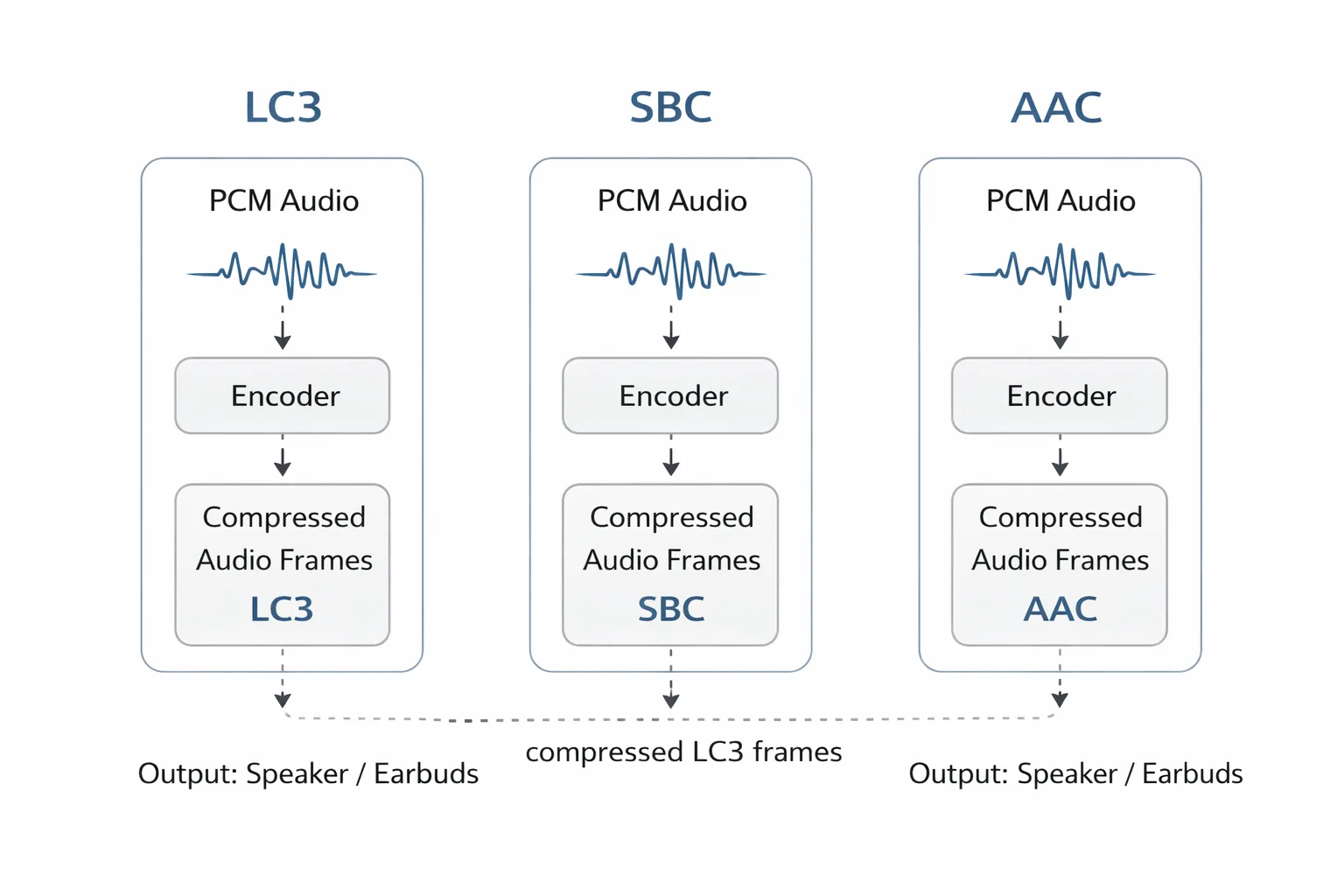
AAC was developed by Apple and is widely used on iOS and some Android devices. AAC provides better audio quality than SBC and is commonly used for listening to music and watching videos on phones and services such as Apple Music and YouTube.
LC3 was developed to replace SBC and is the default codec in Bluetooth LE Audio. LC3 offers better audio quality at lower bitrates, much lower latency, and lower power consumption compared to classic Bluetooth codecs.
| Codec | Audio Quality | Latency & Power |
| SBC | Basic audio quality | High latency, low power consumption |
| AAC | Better than SBC | Medium latency, medium power consumption |
| LC3 | Better audio quality at lower bitrates | Very low latency, much lower power consumption |
Power Efficiency and Battery Impact
LC3 uses much less power compared to other codecs. Because LC3 is part of Bluetooth LE Audio, power consumption on both the phone and the receiving device is lower, which is important for mobile devices.
This is important for mobile devices, headphones, and true wireless earbuds, where battery life directly affects daily use when listening to music, watching videos, and making calls.
Device and Platform Support
LC3 is the default codec in Bluetooth LE Audio, so it will almost automatically be implemented in many transmitting devices. At the moment, headphones and speakers using the LC3 codec are starting to appear more frequently.
Device support depends on Bluetooth hardware and platform support, and not all existing devices can use LC3, which means that both the phone and the receiving device must support Bluetooth LE Audio.
Practical Use Cases
LC3 is suitable for daily use such as listening to music, watching videos, and making calls. LC3 also supports multi-stream, true wireless use cases, and hearing aids, which are part of Bluetooth LE Audio.
Limitations of the LC3 Codec
LC3 does not focus on extremely high bitrates or lossless audio quality. Users who want the highest possible audio quality may prefer other codecs designed for high-resolution audio.
Another limitation is that both the transmitting device and the receiving device must support Bluetooth LE Audio in order to use LC3, which limits usage on existing devices.
Future of LC3 and LE Audio
LC3 was developed to replace the SBC codec that has existed for more than 30 years. As more devices adopt Bluetooth LE Audio, LC3 will be used more widely as the default codec.
Summary
LC3 is a Bluetooth audio codec developed by Bluetooth SIG to replace SBC. It offers better audio quality at lower bitrates, very low latency, and lower power consumption, which makes it suitable for wireless audio use on phones and other Bluetooth devices.